

Finance approves initial augmentations under wildfire special session bills
Significant share of costs should be eligible for FEMA reimbursement, Finance says
The Department of Finance has approved the first departmental augmentations for Los Angeles wildfire disaster response and emergency costs pursuant to ABX1 4, which was signed into law yesterday. ABX1 4 provides up to $1.5 billion of disaster response and emergency funding, and SBX1 3 provides up to an additional $1 billion on top of that, with budget early action possible on related measures, such as bond appropriations for wildfire prevention and forest resilience, in the coming weeks.
ABX1 4 includes a new budget act “control section,” Section 90.00 of the 2024 Budget Act, that allows Finance to augment departmental budgets for emergency response. Below is a summary of Finance’s initial augmentations pursuant to Section 90.00.
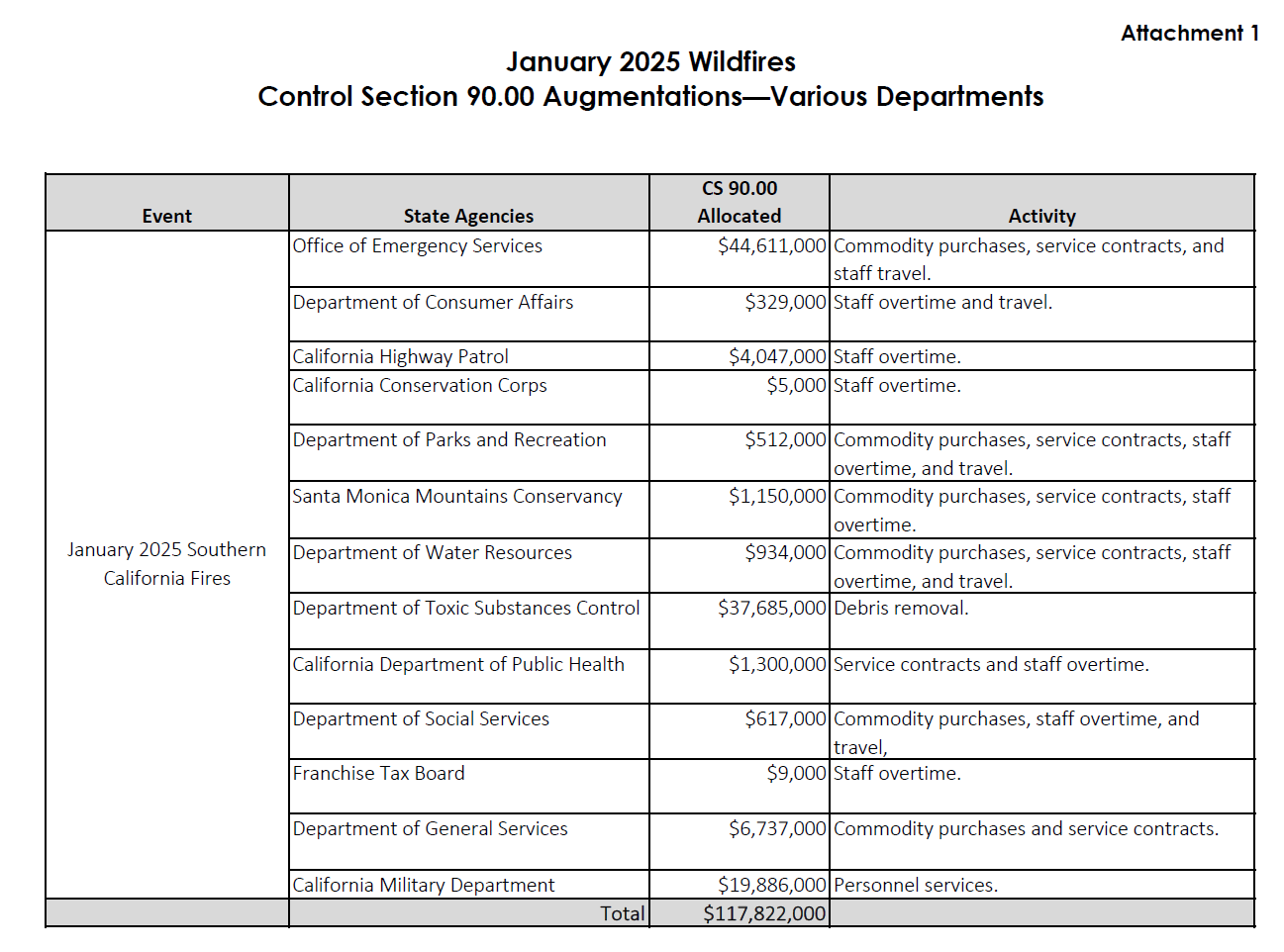
Finance’s official notification to the Joint Legislative Budget Committee today notes that “consistent with the requirements of Control Section 90.01 of the 2024 Budget Act, these augmentations will be included in the Los Angeles Wildfire Response and Recovery Expenditure Report that will be posted on the Department of Finance website on or about February 7, 2025.” (Section 90.01 is a provision that includes reporting requirements in SBX1 3.)
The $2.5 billion is expected to come largely from General Fund or related reserve sources, such as the Special Fund for Economic Uncertainties (the main General Fund reserve). State emergency laws give the Governor broad power to pull from other funds if needed for emergency response.
The notification continues, “A significant amount of these costs will be eligible for reimbursement from the Federal Emergency Management Agency. Although an estimate of this amount is not yet available, the Administration will seek maximum available federal reimbursement. The Governor secured a Presidential Major Disaster Declaration on January 8 and President Biden has approved a 100 percent federal cost-share for eligible emergency protective measures and debris removal costs within the first 180-days of the incident period.”